Where to find low-cost dental care in NYC
The National Institute of Dental and Craniofacial Research, part of the National Institutes of Health, names four low-cost routes: dental schools, community health centers, Medicaid, and clinical trials that sometimes treat the condition being studied for free or at low cost. In New York City the first two do almost all of the work.
| Option | Who treats you | What it costs | Best for |
|---|---|---|---|
| NYU College of Dentistry | Dental students supervised by faculty | Lower than most private practices nearby, per NYU; Medicaid accepted | Full treatment plans, Medicaid patients, walk-in emergencies in Manhattan |
| Columbia College of Dental Medicine, teaching clinics | Dentists-in-training with faculty | Described by Columbia as affordable; no fee schedule posted | Northern Manhattan and the Bronx side of the city |
| Community health center with dental | Staff dentists | Based on your income | Uninsured patients who need care soon |
| Dental hygiene school clinic | Hygiene students, supervised | Reduced | Cleanings and X-rays |
| Clinical trial | Researchers | Sometimes free, for the condition studied only | People who match a study |
| Your Medicaid plan’s network | Private and clinic dentists | Covered services at no or low cost | Anyone with Medicaid |
Stony Brook University’s dental school is in Suffolk County on Long Island, which makes it a trip rather than a neighborhood option for most city residents; if you are considering it, call it directly.
NYU College of Dentistry: how to become a patient
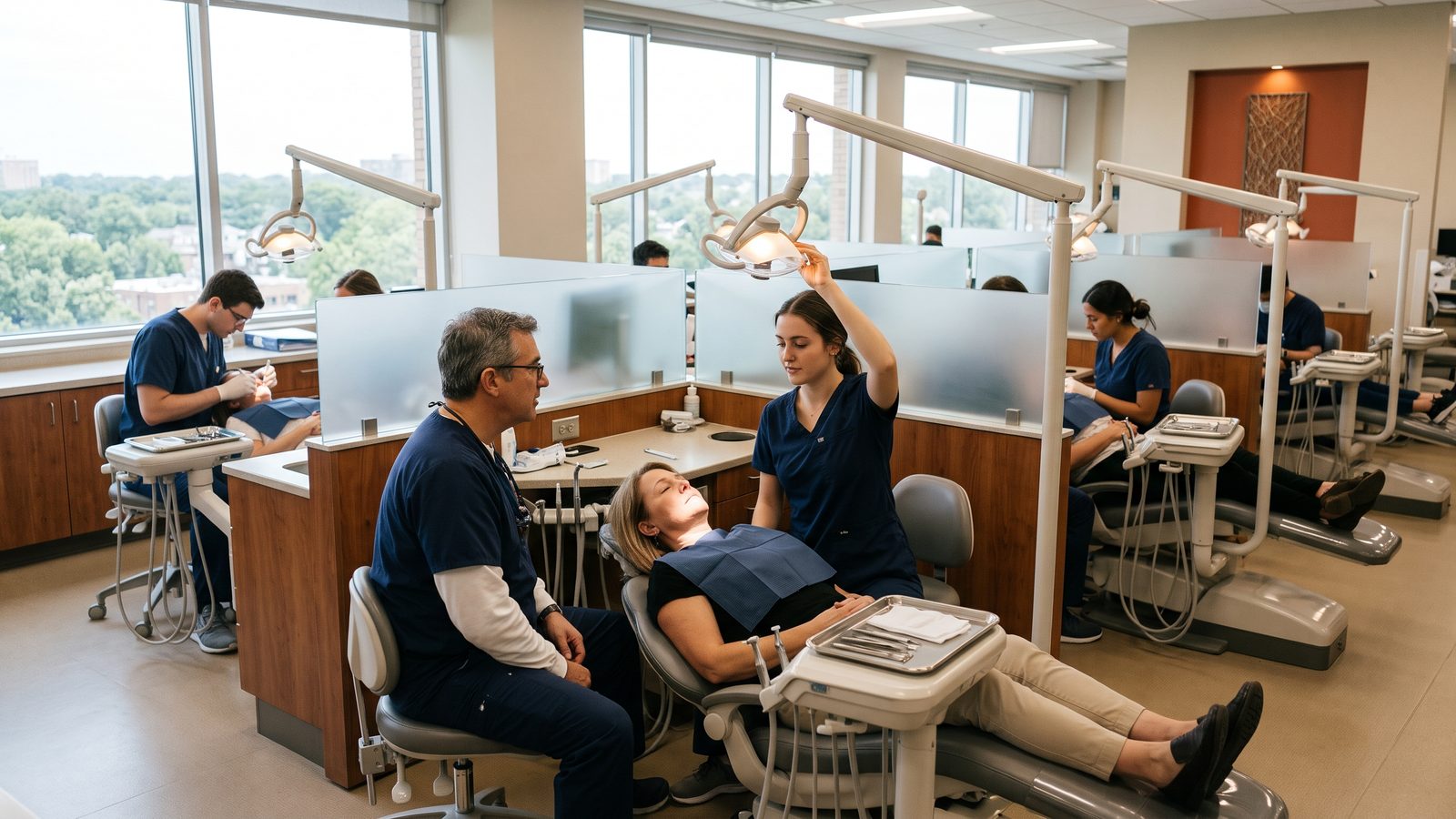
NYU’s patient care page describes a teaching clinic: diagnosis and treatment are performed by dental students under the supervision of NYU faculty. A separate option, the Linhart Continuing Dental Education program, has treatment provided by New York State licensed dentists who are taking continuing education courses.
How to get in. Request a first General Dentistry exam through NYU’s online appointment request form, or call 212-998-9800. Appointment hours are Monday to Thursday 8:00 am to 6:30 pm and Friday 8:00 am to 5:00 pm. NYU also lists a Brooklyn patient care location.
What to bring. Proof of identification (a license, a state ID or a passport) and proof of address (an ID or a bill in your name). Children’s dentistry asks for different documents, so check before a child’s first visit.
How you pay. NYU accepts New York State Medicaid and provides care under the state’s Medicaid managed care programs. It also takes cash, checks, money orders, major credit cards and many FSA cards. Payment is due at the start of each visit, which is worth knowing before a long procedure.
NYU’s emergency dental walk-in
NYU’s Manhattan clinic sees dental emergencies without an appointment, first come, first served:
| Day | Walk-in emergency hours |
|---|---|
| Monday to Thursday | 8:00 am to 3:00 pm |
| Friday | 8:30 am to 12:00 pm |
NYU says hours change on holidays, so check its page the morning you go. Arrive early: first come, first served means a line, and the closing time is when intake stops, not when the last patient finishes.
An emergency dental visit is not the same as an emergency room visit. A hospital ER can treat pain, swelling or infection but usually cannot do the dental procedure itself. A spreading facial swelling with fever or trouble swallowing or breathing is a medical emergency: go to the ER. Your rights in the emergency room.
Columbia’s teaching clinics
Columbia University’s College of Dental Medicine offers two kinds of care, according to its patient care page. Teaching clinics are staffed by dental students and residents under faculty supervision; Columbia describes the care as affordable and says its orthodontic clinic offers care at significantly lower cost than private practices. ColumbiaDoctors Dentistry is the faculty practice, with faculty dentists at several Manhattan locations, priced as a private practice.
The school is at 630 West 168th Street, at the Columbia University Irving Medical Center campus in Washington Heights. The general information line is 212-305-2862, and the teaching clinics page links to an online form to help you choose a clinic.
Columbia’s patient care pages that we checked on November 3, 2026 do not say whether the teaching clinics accept Medicaid or which insurance they take, and they do not post emergency walk-in hours on the main pages. Ask on the first call:
“I’d like to be seen in the teaching clinic, not the faculty practice. Do you accept [Medicaid plan name or ‘self-pay’], and can you give me the fee for the first exam and X-rays?”
Community health centers: priced by income
Federally funded community health centers let you pay “what you can afford, based on your income,” in the words of the NIH dental institute, which points to HRSA’s Find a Health Center tool at findahealthcenter.hrsa.gov. Search by ZIP code and filter for dental services. Not every health center site has a dental clinic, so check the location before you book.
A health center is usually the faster route when you are uninsured and need care soon, because it is set up for that patient. A dental school is usually the better route for a long treatment plan such as several fillings, a root canal and a crown, because the price difference adds up over many visits. What a federally qualified health center is.
Bring proof of income to the first visit, such as pay stubs or a benefit letter. The fee depends on it, and asking the center on the phone which documents it accepts saves a second trip.
Where the low-cost routes stop
Time. A teaching clinic is slower by design. Students work under supervision, which means longer appointments and more of them. If you need something done this week and it is not an emergency, a health center is the better bet.
Not every procedure. A school takes the cases its students need to learn. Complex work may be referred to a residency program or the faculty practice at a different price.
Price lists are not posted. Neither NYU nor Columbia publishes a fee schedule on the pages we checked. Ask for the price of each step in writing before treatment starts, which is your right as a self-pay patient. How a good faith estimate works.
Hospital dental clinics are different. If a hospital bills the visit, New York’s hospital financial assistance law applies: nothing out of pocket at or below 200% of the poverty level. Hospital financial assistance.
Which door, by situation
| Your situation | Where to start |
|---|---|
| Medicaid, need a regular dentist | Your plan’s dental network, or NYU, which accepts Medicaid managed care |
| Medicaid, dental pain today in Manhattan | NYU’s walk-in emergency clinic during its hours |
| Uninsured, need a cleaning or one filling | A community health center with dental services |
| Uninsured, need a long treatment plan | A dental school teaching clinic, with prices in writing first |
| Undocumented, no coverage | A health center or a dental school; NYU’s page asks for ID and proof of address, not immigration status. What coverage you can get |
| Swelling with fever or trouble breathing | The emergency room |
What dental work costs without insurance, and what Medicaid covers for adults in New York, are on dental coverage in New York and what a dental visit costs.
Questions people ask
Does NYU Dental take Medicaid?
Yes. NYU College of Dentistry says it accepts New York State Medicaid and provides care under the state’s Medicaid managed care programs. Payment of any amount you owe is due at the start of each visit.
How do I get an appointment at the NYU dental clinic?
Use NYU’s online appointment request form or call 212-998-9800. Bring photo ID and proof of address. Appointment hours are Monday to Thursday 8 am to 6:30 pm and Friday 8 am to 5 pm.
Does NYU Dentistry take walk-in emergencies?
Yes, at the Manhattan clinic, first come, first served: Monday to Thursday 8 am to 3 pm and Friday 8:30 am to noon. Hours change on holidays.
Is Columbia’s dental clinic cheaper?
Columbia’s teaching clinics, staffed by students and residents with faculty, are described by the school as affordable. Its faculty practice, ColumbiaDoctors Dentistry, is priced as a private practice. Call 212-305-2862 and ask for the teaching clinic.
Where can I get free dental care in NYC?
Fully free care is rare. Medicaid covers dental services for enrollees, community health centers charge by income, and some clinical trials treat the condition being studied at no cost.
Are dental school clinics safe?
Students treat patients under the supervision of licensed faculty dentists at both NYU and Columbia. The trade-off is longer and more frequent appointments, not a lower standard of supervision.
Sources
- NYU College of Dentistry — patient care (checked 2026-11-03)
- Columbia University College of Dental Medicine — patient care (checked 2026-11-03)
- Columbia University College of Dental Medicine — teaching clinics (checked 2026-11-03)
- National Institute of Dental and Craniofacial Research — finding low-cost dental care (checked 2026-11-03)
More in Health Care Costs in New York City
- What an Ultrasound Costs in New York — What does an ultrasound cost? The body part sets the code, and a study done in the ordering doctor's office usually carries no hospital facility fee.
- What Physical Therapy Costs, and Why the Course Matters More Than the Session — How much does physical therapy cost? It is billed in timed units, not per visit, so same-length sessions can differ. Price the whole course, not one visit.
- What Blood Tests Cost, and Why the Draw and the Test Are Two Bills — Blood test cost in New York: one draw can bring bills from three companies, the panel ordered sets the price, and a hospital lab may add a facility fee.
This page explains how the system works. It is not medical advice. More.