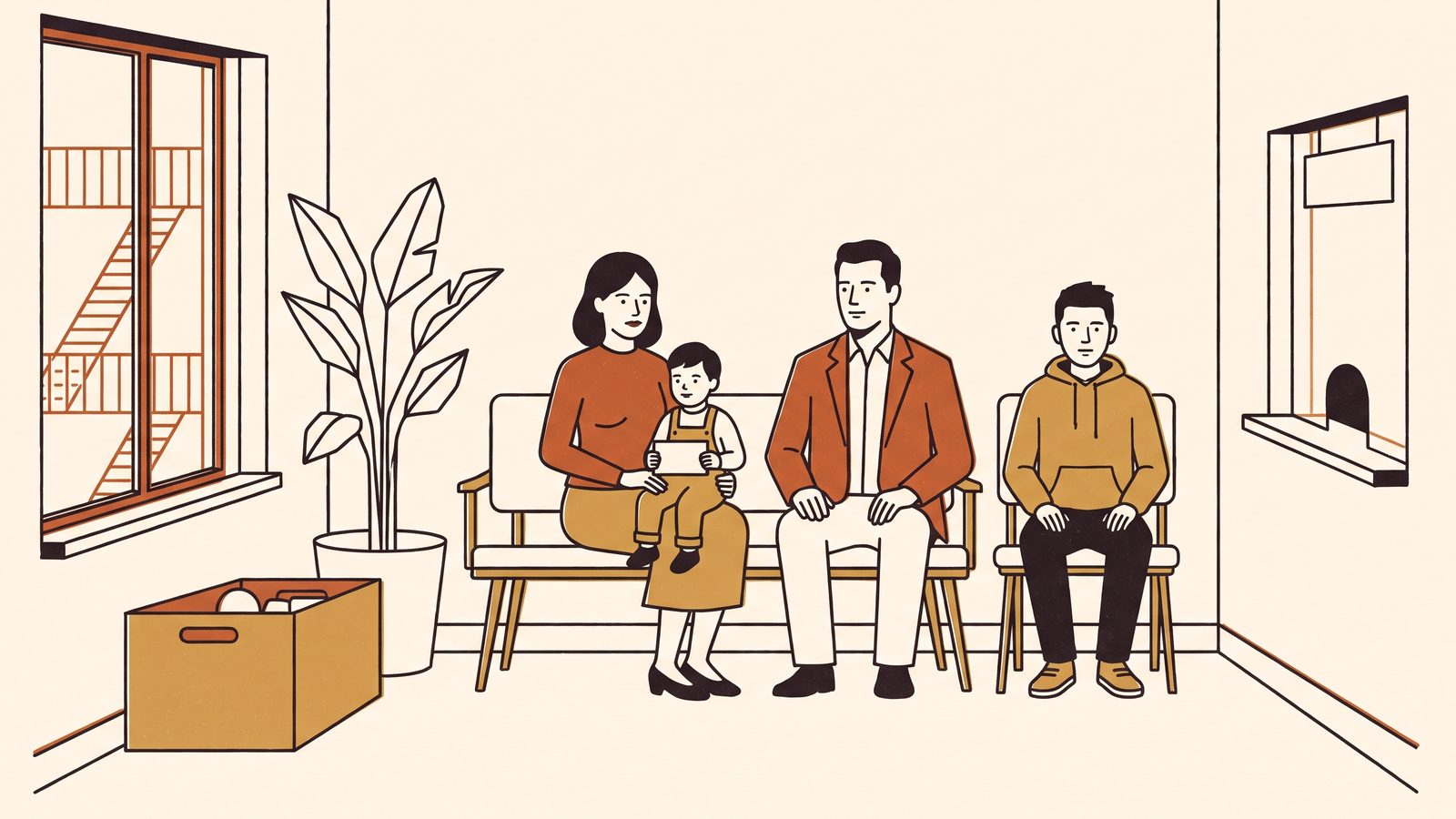
Who Child Health Plus covers
Children under 19 who live in New York State. That is the age boundary, and it is firm: on a child’s nineteenth birthday, the answer becomes an adult program instead.
Two things this program does not require. It does not require a parent to be insured, so children can be covered in a household where the adults are not. And it does not require a particular immigration status for the child, which is the design choice New York made deliberately and the reason this page exists.
What it does require is that the family’s income falls under the Child Health Plus limits, which are set well above the adult thresholds, and that the child is not eligible for Medicaid. If the child qualifies for Medicaid, the application places them there instead, and that is the broader coverage, not the consolation prize.
Status is not a question here
Immigration status is not part of children’s eligibility in New York. Not for Child Health Plus, and not as a reason to hesitate before applying.
Health coverage other than long-term institutional care is not part of the public charge analysis, and Child Health Plus specifically is not counted in it. Hospital and clinic staff are health care workers rather than immigration enforcement. Families are entitled to a free professional interpreter at every point of the process, including registration, the clinical conversation, consent forms and discharge instructions, and a child must never be the one translating for a parent in a medical setting.
If you have an active immigration case and want certainty about your own facts, that question belongs to an immigration attorney. The city has free immigration legal services. What we can say flatly: immigration status and health care intersect far less often than the rumor suggests, and children are the clearest case of all.
Where the income line actually sits
The limit moves with household size, and Medicaid and Child Health Plus interlock at the bottom of the scale. What is reliable to say: the children’s limits are far above the adult ones, and the premium table further down gives the exact 2026 lines for what a family pays.
For contrast, here is the adult Medicaid line for working-age adults without dependent children, roughly 138% of the federal poverty level:
| Household size | 100% FPL | 138% FPL |
|---|---|---|
| 1 | $15,960 | $22,024 |
| 2 | $21,640 | $29,863 |
| 3 | $27,320 | $37,701 |
| 4 | $33,000 | $45,540 |
| 5 | $38,680 | $53,378 |
| 6 | $44,360 | $61,216 |
Each additional person adds $5,680 to 100% FPL. Annual figures.
Children qualify well above those figures. This is why the useful instruction is procedural rather than numeric: apply and let the application do the arithmetic. Families who do the estimate in their head and decide they earn too much are the most common way an eligible child ends up uninsured in this city.
What a family pays for Child Health Plus depends on household income, and the application is what produces that number. Do not assume it is free, and do not assume it is unaffordable. Ask for the figure directly: “What is the monthly cost for my household, per child, at our income?”
What to confirm before you choose a plan
The state sets the benefits and the insurance company sets the network, which means the plan choice is a question about which doctors your children can see, not about which company has better coverage. Get the plan documents and confirm each line below for the plan you are considering.
| What to confirm | Why it matters | How to ask |
|---|---|---|
| Your pediatrician participates | Continuity beats every other feature | Give the practice the exact plan name and the carrier, not just the carrier |
| The children’s hospital you would use is in network | Specialty pediatric care is concentrated in a few systems | “Are you in network for this exact plan for 2027?” |
| Prescriptions your child takes are on the formulary | Drug tiers change annually | Read the drug list, name the medication and the dose |
| Dental, vision and hearing arrangements | These are frequently administered separately | Ask who administers them and how to find a participating dentist |
| Mental health and developmental services | Access varies more than the benefit list suggests | Ask what a referral requires and how long the current wait runs |
| Whether a specialist visit needs a referral or prior authorization | This is what delays care in practice | Ask who submits it, the practice or you |
The method is the same one that applies to every program in the state, and it takes about an hour: how to compare carriers by network.
How to apply, in order
- Apply at NY State of Health, online or at 1-855-355-5777. The line has interpreters, and you can ask for one without explaining why.
- List every household member, including adults who are not applying. The application needs the whole household to calculate eligibility for the children.
- Have income documentation ready: pay stubs, an employer letter, a tax return, or a self-attestation if the household is paid in cash. Cash work does not disqualify anyone.
- Have proof of New York residence and identification for the child and the applying adult.
- Let the application sort the child. It screens for Medicaid and Child Health Plus together, and the placement is automatic.
- Choose the plan by network, using the checklist above.
- Write down the application number and the date. When you call back, that number is the difference between a five-minute call and a thirty-minute one.
A certified navigator can sit with you through all seven steps for free and earns no commission, unlike a broker. Community organizations across the boroughs employ them, frequently in the language your household speaks at home.
If the parents have no coverage
This is the most common shape of the problem in New York City: children enrolled, adults uninsured. It happens because the children’s thresholds sit so much higher than the adult ones. It is not a mistake in your application.
What is available to the adults in that household:
- The Essential Plan if they are 19 to 64, lawfully present, and at or below 200% of the federal poverty level. $0 premium, no deductible, no season.
- NYC Care if status is the barrier. No immigration requirement, no income threshold for membership, and enrollment by phone at 1-646-692-2273.
- Hospital financial assistance for bills that already exist. Every hospital in the state is required to have a program, and immigration status is prohibited from being considered in it.
- Emergency Medicaid for an emergency condition including childbirth, arranged at the hospital through the financial assistance office or a social worker.
The full map of free and low-cost options sorts these by situation.
Renewals, and the birthday that ends it
Child Health Plus renews, and renewal notices go to the address and email on file with NY State of Health. A stale address is the leading reason families lose coverage they still qualify for, and it surfaces at a pharmacy counter rather than in a letter you can act on. Update your contact information the week you move.
Where this gets harder than the brochure suggests
Three limits worth knowing before you rely on the coverage.
Pediatric specialty networks are narrower than general ones. A plan can look complete and still route you to a long wait for a developmental evaluation or a pediatric subspecialist. Ask about the current wait when you confirm the network, not after enrollment.
Dental participation is thinner than medical. The benefit exists; finding a practice that takes it takes more calls. Start that search before you have a toothache in the household.
Switching carriers mid-treatment is disruptive. If a child is in the middle of a course of care, ask about continuity arrangements before changing plans, and get the answer from the new plan rather than the old one.
What the family pays, per child, in 2026
The state Department of Health publishes the premium tiers, and they run off the federal poverty level:
| Household | 222% free up to here | 250% $15 per child | 300% $30 per child | 350% $45 per child | 400% $60 per child |
|---|---|---|---|---|---|
| 1 | $35,431 | $39,900 | $47,880 | $55,860 | $63,840 |
| 2 | $48,040 | $54,100 | $64,920 | $75,740 | $86,560 |
| 3 | $60,650 | $68,300 | $81,960 | $95,620 | $109,280 |
| 4 | $73,260 | $82,500 | $99,000 | $115,500 | $132,000 |
| 5 | $85,869 | $96,700 | $116,040 | $135,380 | $154,720 |
| 6 | $98,479 | $110,900 | $133,080 | $155,260 | $177,440 |
Each additional person adds $5,680 to 100% FPL. Annual figures, before taxes.
The premium is charged for at most three children, so a family with four children in the $15 tier pays $45 a month in total. Above 400% of the poverty level the family pays the full premium, which varies by plan. In household terms: a family of four earning up to $73,260 pays nothing, and one earning $99,000 pays $30 per child. All 2026 thresholds in one table.
Questions people ask
Do I need papers for my child to be covered?
Immigration status is not a requirement for children’s coverage in New York, and Child Health Plus is not part of the public charge analysis. You do need proof of identity, New York residence and household income to complete the application.
My income went up. Do we lose the coverage?
Not automatically. Report the change to NY State of Health and let the application recalculate. Children’s income limits are substantially higher than adult ones, so a raise that ends your own eligibility frequently does not end theirs.
Can my child stay with the same doctor?
Only if that doctor participates in the plan you choose. Call the practice, give the exact plan name and carrier, and confirm for the coming year. Networks change annually, and nobody sends a letter you would notice.
Is Child Health Plus the same as Medicaid?
No. Medicaid covers lower incomes and includes benefits Child Health Plus does not, notably long-term care. One application screens for both, and it places your child in the right one automatically.
We missed open enrollment. Are we too late?
No. Child Health Plus, Medicaid and the Essential Plan take applications every month of the year. The November to January window applies to marketplace plans only.
Sources
- NY State of Health (checked 2026-08-12)
- New York State Department of Health — Medicaid (checked 2026-08-12)
- HHS 2026 Poverty Guidelines (Federal Register, January 15, 2026) (checked 2026-08-12)
- NYS Department of Health — Child Health Plus eligibility and cost (checked 2026-09-07)
More in Coverage
- Medicaid Work Requirements in New York, 2027: Who Must Report 80 Hours and Who Is Exempt — From 2027, many Medicaid adults 19 to 64 must show 80 hours a month or an exemption. Letters by September 30, checks from March renewals. What to do now.
- Medicare Savings Programs in New York: Who Pays Your Part B Premium — New York's Medicare Savings Programs pay your Part B premium and, at lower incomes, Medicare cost sharing. The 2026 monthly limits, no asset test, where to apply.
- The 20-Minute Renewal Checklist for NY State of Health — A printable checklist for reviewing a marketplace plan before it auto-renews: premium, credit, doctors, drugs, deadlines, and the three phone calls that settle each one.
This page explains how the system works. It is not medical advice. More.