Why “I need Spanish” is the wrong request for much of this neighborhood
Spanish is the working language of a large share of health care in Jackson Heights, and that is exactly what makes the other languages harder to get. A registration clerk who hears the word “interpreter” reaches for the option used forty times a day. If what you need is Bengali, Nepali, Tibetan, Urdu or Punjabi, the request has to carry the language name, or it gets rounded off to the nearest common one and nobody notices.
Spanish is not one thing here either. Colombian, Ecuadorian, Mexican and Dominican patients share a language without always sharing the vocabulary for symptoms, body parts and dosing. Most of the time a general Spanish interpreter is fine. When it isn’t, say which country’s usage you follow, at the desk, before anyone starts explaining anything.
The rule that survives contact with a busy clinic: the language goes in the sentence, and the sentence goes to registration before you are taken to a room.
A bilingual front desk is not an interpreter
Someone who can check you in in Nepali is not the same as someone trained to carry a clinical conversation, and the gap shows up where it costs most: consent forms, discharge instructions, and the explanation of what a medication does and when to stop taking it.
The right covers the whole visit rather than the exam room alone. Registration, the clinical conversation, consent paperwork, discharge and medication instructions, the pharmacy counter and any discussion about a bill all sit inside it. You cannot be charged for interpretation, and you cannot be required to bring somebody with you.
The sentence that works:
“I’m requesting a professional interpreter in Tibetan. Please note in my chart that I asked.”
The second half does the work. A documented request changes what happens at the next visit, and it is the only record that exists if you later need to complain. How that right works in practice is worth reading once before you need it.
The type of place you walk into decides the bill
Jackson Heights has no shortage of places to be seen. What varies is how each one turns a visit into a charge, and that is settled before you sit down.
| Type of place | How the bill works | Who it fits |
|---|---|---|
| Community health center (federally funded) | Sliding scale by household income; uninsured patients are routine | Primary care, prenatal, pediatrics, ongoing conditions |
| Private practice | Depends entirely on whether they participate in your exact plan | Anyone whose plan they actually take |
| Hospital outpatient clinic | Facility fee plus a separate physician fee, with labs and imaging billed on their own | Specialty care and procedures |
| Urgent care | A visit charge, plus separate charges for anything sent to a lab | Same-day problems that are not emergencies |
| Emergency department | The most expensive door in the system, and the only one obligated to see everyone | Emergencies |
| NYC Health + Hospitals and Gotham Health clinics | NYC Care pricing: no charge at or below 200% of the federal poverty level | Uninsured residents, any immigration status |
The federal directory at findahealthcenter.hrsa.gov is the reliable way to pull a current list of the health center layer by ZIP code. For the choice between the last two rows, urgent care versus the emergency room works the same way in every part of the city.
What to ask on the phone before the first visit
Booking a first appointment here is a five-question phone call, and skipping it is the most common way people end up with a bill they did not expect.
- “Do you participate with [exact plan name], and are you taking new patients under it?” The plan name matters more than the category. “Medicaid” is not an answer; the name of the managed care plan printed on your card is.
- “Is this office billed as a hospital outpatient department?” If the answer is yes, expect a facility fee on top of the physician charge.
- “Do you have phone interpretation in [language]?” Ask when you book, not when you arrive.
- “I have no insurance. Can you send me a written estimate before the visit?” Federal rules require a good faith estimate for scheduled care when you are uninsured, and a final bill far above it can be disputed.
- “What happens if I run late?” A practical question in a neighborhood where appointments get booked around shift work.
Coverage that does not ask about immigration status
Three programs at NY State of Health take applications year round, with no season to miss: Medicaid, the Essential Plan and Child Health Plus. The Essential Plan carries a $0 premium and no deductible for lawfully present adults aged 19 to 64 with income at or below 200% of the federal poverty level. Child Health Plus covers children under 19 with no immigration status requirement, at family income limits well above the adult ones. The state line is 1-855-355-5777, and certified navigators there are free and earn no commission.
If insurance itself is out of reach, NYC Care is the other route. It is not insurance. It is access to the city’s public hospitals and clinics, with no immigration status requirement and no income threshold to join. At or below 200% of the poverty level there is no charge for primary care, specialists or labs; above that a sliding scale applies, with clinic visit copays in the range of $20 to $30. The number is 1-646-692-2273.
If a hospital bill already arrived
New York’s financial assistance law applies to every hospital in the state, including for-profit ones, and it does not care which door you came through. At or below 200% of the federal poverty level, a hospital may not charge an uninsured patient out-of-pocket costs for medically necessary care. Between 201% and 300%, the charge is capped at 10% of the Medicaid rate for that service, and between 301% and 400% at 20%.
Two details people miss. Insured patients qualify too, when medical bills over the last twelve months exceed 10% of gross annual income. And you can apply at any stage of collection, including after the account has gone to a collection agency, which is when most people assume it is too late.
Immigration status may not be considered in that decision. The application mechanics and a rough eligibility check are on separate pages.
Every facility the federal registry lists here
What exists in the neighborhood, per the federal registry
18 organizations registered in NPPES with an address in this neighborhood. Name, type and address come from the registry. Phone numbers and accepted plans are not in it, which is why they are not published here.
| Type | Organization | Address |
|---|---|---|
| Community health center | Departement Of Health And Mental Hygiene NPI 1104176395 | 3433 Junction Blvd Jackson Heights 11372 |
| Medical specialty clinic | G & B Healthcare Medical Pllc NPI 1376929695 | 9108 Elmhurst Ave Jackson Hts 11372 |
| Medical specialty clinic | Verrisa Medical Services NPI 1437339934 | 8910 35Th Ave Jackson Heights 11372 |
| Mental health clinic | South-Magellan Corporation NPI 1962607580 | 3753 90Th St, 2Nd Floor Jackson Heights 11372 |
| Multi-specialty clinic | Jsj Medical Group 2 NPI 1578881579 | 9207 Roosevelt Ave Jackson Heights 11372 |
| Multi-specialty clinic | Servicios Medicos Hispanos Queens, P.C. NPI 1447263892 | 9014 Elmhurst Ave Jackson Heights 11372 |
| Primary care clinic | Alvaro Ramirez Physician Pc NPI 1528144268 | 8818 37Th Ave Jackson Heights 11372 |
| Primary care clinic | Ap Medical Care Pc NPI 1972159333 | 3506 73Rd St Ste 2 Jackson Heights 11372 |
| Primary care clinic | Ideal Pediatric Care Pc NPI 1053746651 | 3751 75Th St Jackson Heights 11372 |
| Primary care clinic | International Pediatrics Plus NPI 1629284237 | 9320A Roosevelt Avenue, 2Nd. Floor Jackson Heights 11372 |
| Primary care clinic | Kls Medical, Pc NPI 1215113949 | 3741 77Th St Jackson Heights 11372 |
| Primary care clinic | Pediatrics For Queens & Kings NPI 1396955878 | 9542 Roosevelt Ave Jackson Heights 11372 |
| Primary care clinic | Rrg Medical Practice, Pc NPI 1720383714 | 3736 90Th St Fl 1 Jackson Heights 11372 |
| Primary care clinic | Sherman Pediatrics Care Pllc NPI 1578772752 | 4312 43Rd St Sunnyside 11104 |
| Primary care clinic | Stat Medical Care NPI 1316131147 | 9542 Roosevelt Ave Jackson Heights 11372 |
| Urgent care | City Medical Of Upper East Side, Pllc NPI 1255742342 | 7302 Roosevelt Ave Jackson Heights 11372 |
| Urgent care | Hillside Urgent Care Pllc NPI 1407240583 | 16403 Hillside Ave Jamaica 11432 |
| Urgent care | Urban New York Medical Pc NPI 1700222353 | 2818 Steinway St Astoria 11103 |
How to use this table. It tells you what kind of facility exists and where — not whether they take your plan or accept new patients. Those change constantly and only a phone call settles them. A federally qualified health center charges on a sliding scale by income; a hospital-owned urgent care may add a facility fee; a hospital bills through several entities at once.
Getting there is part of whether you go
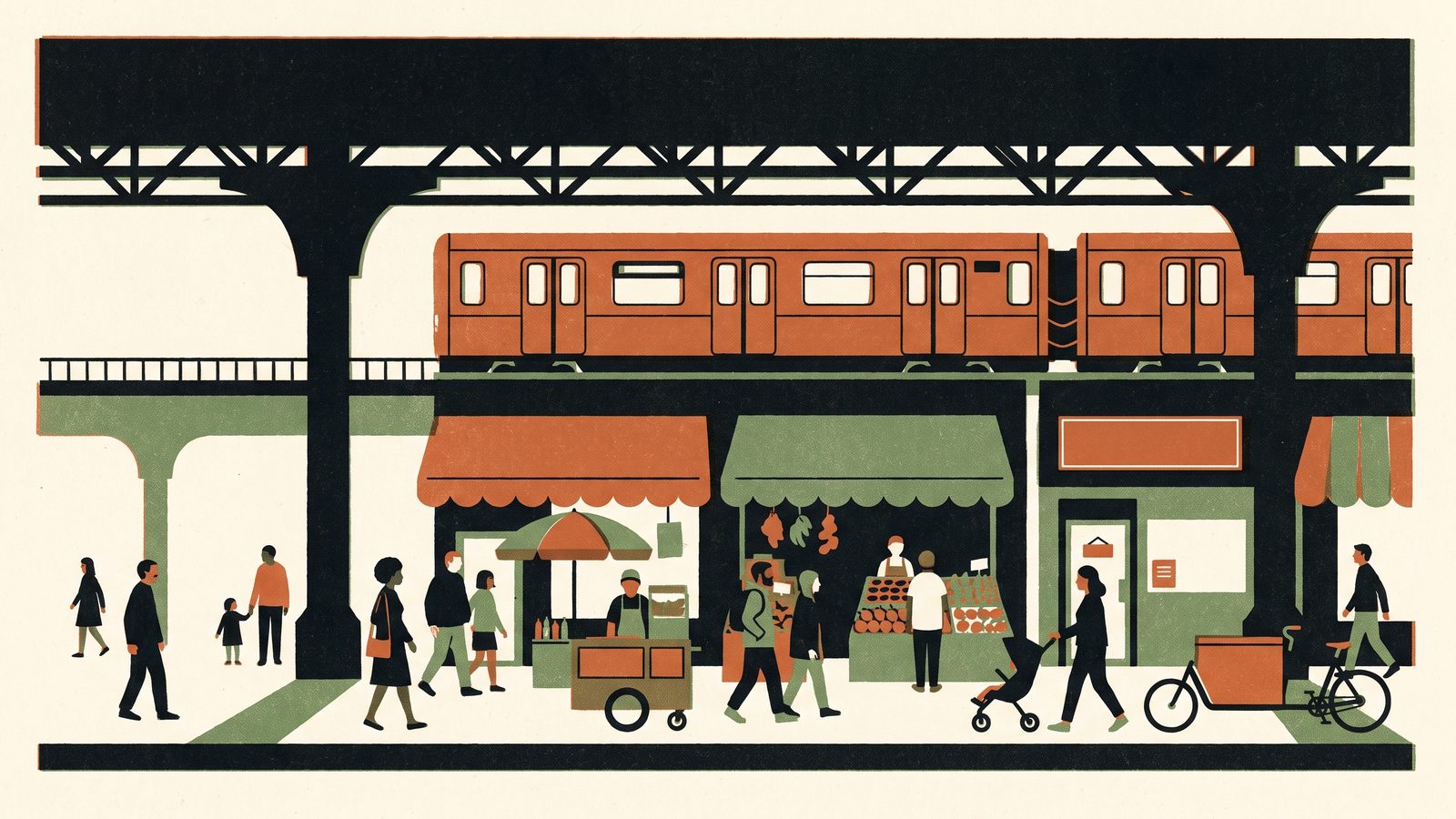
The 7 train, the elevated stretch along Roosevelt Avenue and the bus routes make most of this neighborhood reachable, so distance is rarely the reason an appointment gets missed. Scheduling is. People working two jobs, or shifts that change week to week, book a mid-morning slot in good faith and then cannot leave.
Three things to ask for when you book, in this order: the first appointment of the day, because the clinic is running on time then; evening or weekend hours if the practice has them; and the specific entrance and floor, because an appointment you cannot physically find is an appointment you missed.
A missed appointment is not a neutral event. It usually gets rescheduled weeks out, the condition keeps moving, and the visit ends up happening in an emergency room instead, at the most expensive price in the system. Rescheduling by phone the day before costs nothing.
Questions people ask
Do I have to prove immigration status to be seen here?
No. Emergency departments must see and stabilize anyone under federal law, community health centers and the public system see patients regardless of status, and hospital financial assistance decisions may not consider it.
Which language should I name if I speak two?
Name the one you want the medical conversation in, which is usually the one you grew up with rather than the one you work in. Medical vocabulary is the first thing that drops out of a second language under stress.
The clinic says nobody speaks my language today. Is that the end of it?
No. Phone and video interpretation services carry far more languages than any single site staffs, and reaching one is a matter of minutes. Ask specifically for the telephone interpreter line.
Will using NYC Care or Child Health Plus count against a green card application?
Health coverage other than long-term institutional care is not part of the public charge analysis. NYC Care, Child Health Plus, Emergency Medicaid and hospital financial assistance are not counted. More on status and care.
I have a plan but no doctor. Where do I start?
Call the number on the back of the card and ask for a primary care doctor near your ZIP code who is taking new patients and speaks your language. That is a request the plan is obligated to handle, and it is faster than working through the online directory.
Sources
- New York State Department of Health (checked 2026-08-12)
- NYC Care (checked 2026-08-12)
- HRSA — find a health center (checked 2026-08-12)
More in Neighborhoods
- Corona: Getting Covered When You're Paid in Cash — Corona has one of the city's highest uninsured rates. How to prove income without pay stubs, and why cash work is not a barrier to NYC Care or financial help.
- Elmhurst: Living Next to a Public Hospital — What it changes to live beside the NYC Health + Hospitals system: how public hospital billing differs, what NYC Care adds, and how to use both on purpose.
- Getting Care in Brighton Beach and Sheepshead Bay: The Medicare Choice New York Lets You Undo — The Medicare Advantage pitch arrives here each fall, often in Russian. In New York the choice is reversible: supplements are sold any month, whatever your health.
This page explains how the system works. It is not medical advice. More.