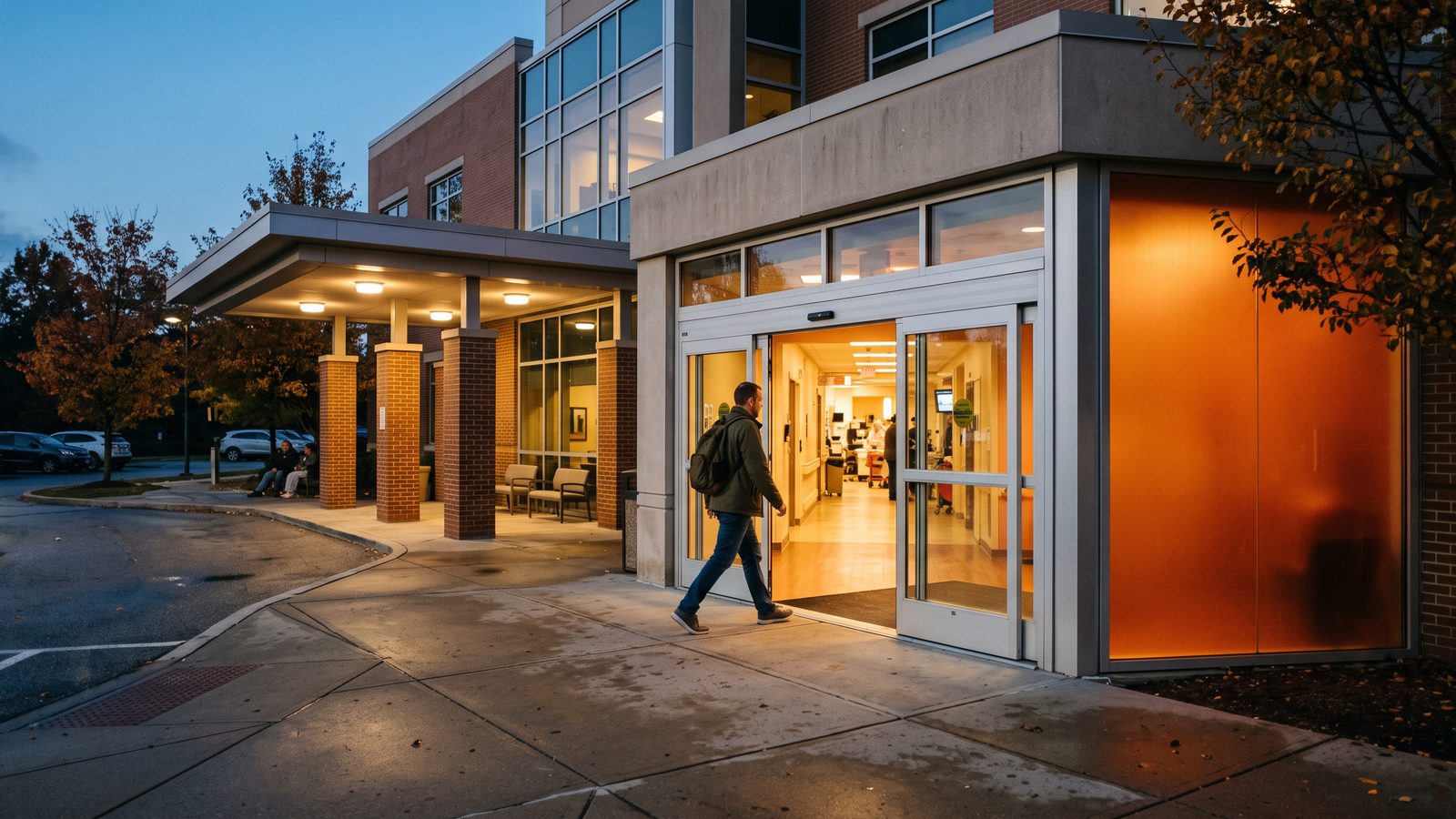
Can an emergency room turn you away for not having money?
No. Any hospital emergency department participating in Medicare, which is effectively all of them, must give a medical screening examination to anyone who arrives to determine whether an emergency condition exists. If one exists, the hospital must stabilize it before discharge or transfer. That is the federal Emergency Medical Treatment and Active Labor Act, usually called EMTALA.
Three things are explicitly outside the calculation: your insurance, your ability to pay and your immigration status. Whether you owe that hospital money from an earlier visit is not a condition either. A hospital may not delay screening to run a payment check.
The obligation covers labor and delivery. It attaches to hospital emergency departments, not to urgent care centers, which are private businesses and can decline patients. If you are told to leave before being seen, ask the sentence that names the obligation: “Am I being refused a medical screening examination?” What an emergency room must do.
What does EMTALA require, and what does it not?
EMTALA settles whether you are seen; it does not settle what the visit costs. The obligation is screening and stabilization. Payment is settled afterward, and a bill can still arrive.
| EMTALA requires | EMTALA does not require |
|---|---|
| A medical screening examination for anyone who arrives | Free care |
| Stabilization of an emergency medical condition | Follow-up treatment after the emergency |
| Care during active labor | Admission when screening finds no emergency condition |
| Screening without a payment check first | Care at an urgent care center |
| Transfer only once stable, or when the receiving hospital can provide care the first cannot | Treatment of non-emergency conditions |
Transfer is not permitted as a way to avoid treating you. If screening finds no emergency condition, the obligation is met, and the hospital’s duties after that point come from other rules.
Refusal to screen is a violation. Complaints go to the Centers for Medicare & Medicaid Services and to the New York State Department of Health.
What happens after the emergency is over?
Once you are stable, EMTALA stops and New York’s hospital financial assistance law takes over the money question. Under Public Health Law section 2807-k, as amended effective October 20, 2024, every hospital in the state, including for-profit hospitals, must run a financial assistance program for emergency and medically necessary care.
The ongoing treatment problem is real: EMTALA covers the emergency, not the follow-up. Ask at discharge who you should see and how soon, because that planning is the part people skip.
New York’s 2024 package also lists denying admission or treatment because of an unpaid bill among the things a hospital may not do. Billing offices may still raise an old balance before scheduled care. The answer is to run the financial assistance process on that balance rather than let it sit, because the application can be made at any stage, including after the account reaches a collection agency. Hospital financial assistance, step by step.
How much can the hospital charge you afterward?
New York caps what a hospital may charge by household income, measured against the federal poverty level. For emergency care, the hospital’s primary service area does not matter; that limit applies only to non-emergency care.
| Household income | Uninsured patient | Insured patient (share after the plan) |
|---|---|---|
| At or below 200% FPL | Nothing out of pocket | Nothing out of pocket |
| 201% to 300% FPL | No more than 10% of the Medicaid rate | No more than 10% of what the plan leaves you |
| 301% to 400% FPL | No more than 20% of the Medicaid rate | No more than 20% of what the plan leaves you |
| Above 400% FPL | Statewide floor ends; apply under the hospital’s own policy | Same |
In 2026, 400% of the poverty level is $63,840 for one person and $132,000 for a family of four. Insured patients qualify when out-of-pocket medical costs over the last 12 months exceed 10% of gross income. The hospital may not ask about assets and must decide within 30 days of a complete application, in writing. Run your numbers.
Can a hospital make you leave a credit card on file?
No. Since October 2024, New York bars hospitals and providers from requiring a credit card on file or a pre-authorization as a condition of care. If registration asks, you can decline: “You may not require a card on file.”
The rule matters for more than the moment at the desk. A medical bill charged to a credit card becomes ordinary credit card debt, and the protections built around hospital bills stop applying to it: the financial assistance tiers, the 180-day wait before collections, and the 2% cap on payment plan interest. New York’s Fair Medical Debt Reporting Act, which bars hospitals and providers from reporting medical debt to credit bureaus, does not protect medical debt charged to an ordinary credit card.
If you have already paid, ask anyway whether the hospital refunds patients who qualified at the time of service. Some do, and it is worth one letter.
Does immigration status change any of this?
No. The EMTALA obligation is identical for an undocumented patient, and hospital staff are health care workers, not enforcement. New York’s financial assistance law applies irrespective of immigration status; status may not be considered in the decision, and hospitals may not report applicants to immigration authorities.
Registration will ask for identification and insurance. Answer what you can. You can decline to give a Social Security number; care does not depend on it.
For the bill, Emergency Medicaid can cover treatment of an emergency condition, including delivery, for people who meet Medicaid’s income rules but not its immigration rules. It is applied for at the hospital, usually after the care. Ask: “Was I screened for Emergency Medicaid?” Immigration status and medical care.
What to do, in order
- Go to the emergency department. Delaying emergency care over money is the most expensive decision in this system.
- At registration, say what you have and what you don’t. “I don’t have insurance.” Decline a card on file if asked.
- If refused before screening, ask: “Am I being refused a medical screening examination?” Note the time and the name of the person.
- At discharge, ask about follow-up: who to see and how soon.
- When the bill arrives, request an itemized bill and apply for financial assistance, asking that collection activity pause.
- Know the rest of your hospital rights. The state’s 21-item Patients’ Bill of Rights covers interpreters, refusing treatment, discharge appeals and complaints.
- Hold the hospital to the collection limits: no collections or lawsuit within 180 days of the first bill, none while an application is pending, and no lawsuit if household income is under 400% of the poverty level. Every law with its date.
Questions people ask
Can a hospital refuse to treat you if you can’t pay in New York?
Not in an emergency. Federal law requires every hospital emergency department participating in Medicare to screen anyone who arrives and stabilize an emergency condition, regardless of insurance, ability to pay or immigration status.
Can a hospital turn me away because I owe them money?
Not for emergency screening and stabilization. An old balance does not remove that obligation. For the old balance itself, apply for financial assistance, which is accepted at any stage, including after collections.
Does EMTALA mean emergency care is free?
No. It requires screening and stabilization, not free care. The bill is settled afterward, and New York’s financial assistance law caps it by income up to 400% of the poverty level.
Can the emergency room ask for my credit card?
A hospital may not require a credit card on file or a pre-authorization as a condition of care. That rule has been in force in New York since October 2024.
Can an undocumented immigrant be refused emergency care?
No. The obligation to screen and stabilize does not depend on immigration status, and status may not be considered in a New York hospital financial assistance decision.
Where do I report a hospital that refused to screen me?
To the Centers for Medicare & Medicaid Services and to the New York State Department of Health.
Sources
- Emergency Medical Treatment and Active Labor Act (overview) (checked 2026-08-12)
- New York State Attorney General — Hospital financial assistance (Public Health Law § 2807-k) (checked 2026-09-07)
- NYS Department of Health — Dear CEO letter DAL 24-01 on the amended Hospital Financial Assistance Law (October 18, 2024) (checked 2026-09-07)
- NY Health Access — NYS Hospital Financial Assistance Law (checked 2026-09-07)
- NYC Health + Hospitals (checked 2026-08-12)
More in Patient Rights in New York
- Getting Care in Russian in New York: The City's Language Rules Stop Before Your Medicare Plan — Russian is a designated city language in New York, but that rule stops before your Medicare plan. Ask by name for the Medicare Savings Programs: QMB and QI.
- How to Appeal a Denied Claim in New York — What to do when a plan denies prior authorization or refuses to pay a claim in New York: written denial, peer-to-peer review, internal appeal, external appeal.
- Getting Care in Bengali in New York: Naming the Language Is Not the Same as Naming the Variety — Need a Bengali interpreter in New York? Bengali and Sylheti are not the same. Say which one you speak, and say it again if the wrong interpreter arrives.
This page explains how the system works. It is not medical advice. More.